6 Trends That Changed HR Over the Past Decade
Technology, social media and the gig economy are among the forces that have impacted the practice of HR.
Introduction
The world of work has changed dramatically in the past decade, shaped by factors that include a brutal recession, technological advances and a new generation of workers with very different ideas of what employment should look like.
Ten years ago, companies surveyed by the SHRM Foundation said their top future challenges were succession planning and providing leaders with the skills needed to be successful. Today, employers say the increasing competition for skilled workers is a top concern. As a result, the workplace is much more employee-focused and individualized. That’s pushing employers to, among other things, provide flexible schedules to people with family obligations or give tuition help to entry-level workers so that they can get a new job — somewhere else.
“I would say [HR is] moving from processing paper to making sure individuals feel valued in the organization,” says Kate Bischoff, SHRM-SCP, an employment attorney at tHRive Law & Consulting LLC, which is based in the Minneapolis-St. Paul area. The work is “much more personalized than it has ever been before.”
The trend toward an employee-tailored workplace is likely to continue, and you may need to adjust quickly if you haven’t already started. “We’re going to now see this shift to employee value, and this is critical. It’s the deficit we see today in HR,” says Rusty Lindquist, vice president of human capital management strategy and intellectual property at HR software company BambooHR, which is based near Salt Lake City. HR’s traditional emphasis on payroll, benefits and procedures will need to broaden. “The HR of the next decade has to be more focused on performance and productivity. And that’s going to require a seismic shift in thinking.”
So what has changed over the past decade, and how will those trends evolve in the years to come?
1. Companies Get Social
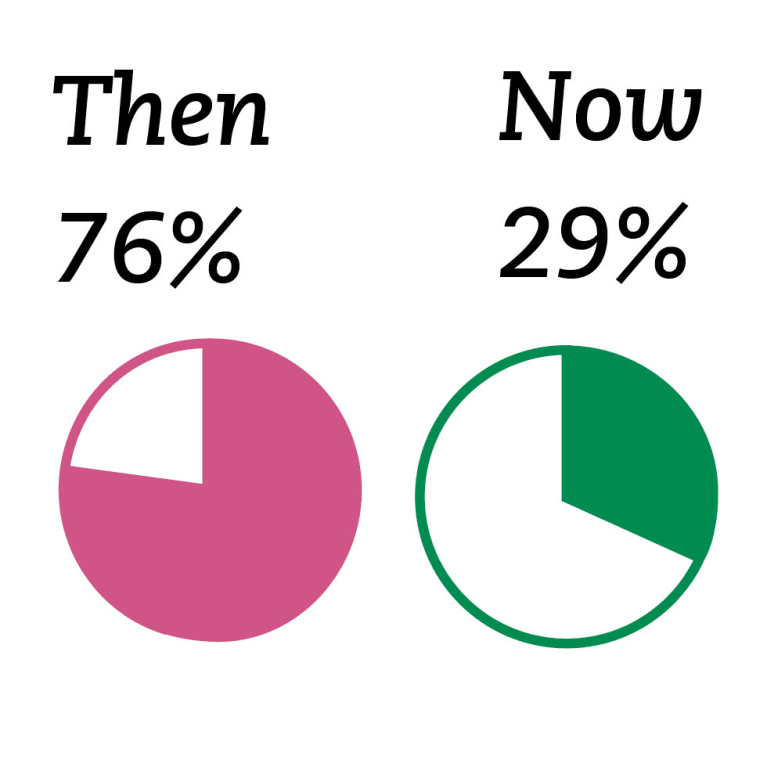
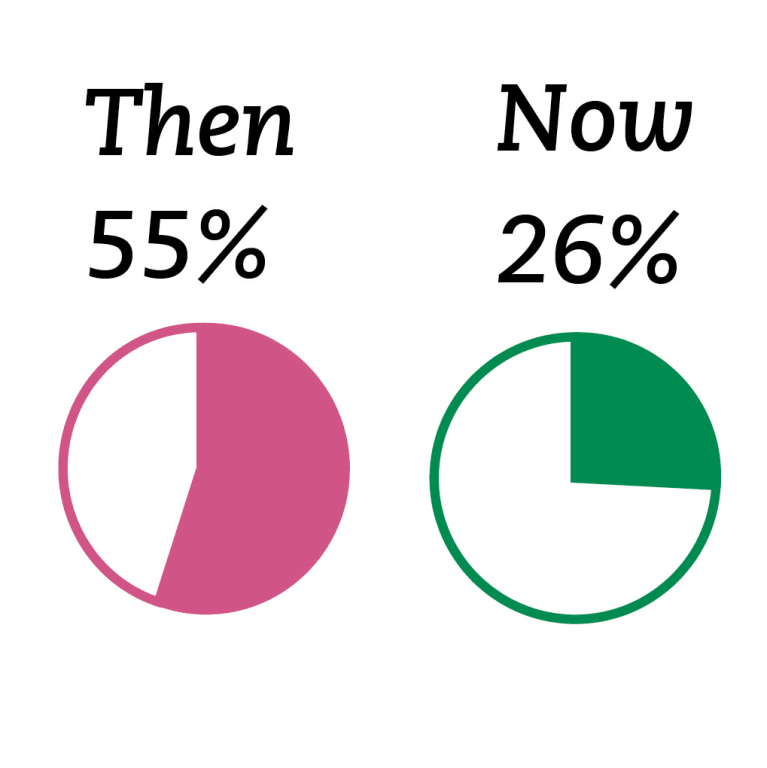 THEN: Ten years ago, social media was fairly new and a little unsettling for business leaders and HR. Twitter was just 1 year old, and Facebook was thought of mainly as a distraction that threatened to decrease productivity. Two-thirds of employers used technology to block connections to banned websites in 2006, 3 out of 4 monitored which websites workers visited and more than half monitored employees’ e-mails, according to a BambooHR study of HR trends.
NOW: A more relaxed attitude prevails. Last year, just 30 percent of organizations blocked access to certain sites and even fewer kept an eye on what workers were viewing and e-mailing, according to BambooHR.
 Of course, company leaders fully understand that social media can be distracting—and will continue to be for as long as there are cute cat videos to share—but they also realize that trying to control employees’ online lives at work is likely futile and perhaps even counterproductive. Social media is “how people are used to finding information and communicating. If you limit it too much, it’s going to stifle them,” says Donatella Verrico, chief human resources officer at law firm Lowenstein Sandler in Roseland, N.J.
WHAT’S NEXT: In the next decade, companies may well abandon e-mail and use social media or other instant messaging tools as their primary internal communication vehicle, predicts Shawn Casemore, president of Ontario, Canada-based management consulting firm Casemore and Co. Inc.
2. Benefits Go a la Carte
THEN: Health and retirement programs were among the most common benefits employers provided, and benefit offerings were relatively limited.
NOW: Employees still value the basics, but they also want more flexible and individualized benefits. Companies have responded by recalibrating their perks to remain competitive in the war for talent. Retail giant Amazon, for example, offers its hourly employees a generous tuition benefit and onsite schooling. The startling detail? The company trains workers for jobs outside of Amazon.
The Career Choice program offers up to 95 percent reimbursement of tuition and fees (up to $12,000 over four years) to train employees in high-demand fields in regions where they work. They can learn about aircraft mechanics, machine tool technologies and nursing, for example.
“Being able to advertise such a program helps with recruiting,” says Juan Garcia, Amazon’s global leader for associate career development. And internal studies show that participants have one-fourth the attrition rate of nonparticipants. Nearly 10,000 people have taken advantage of the benefit.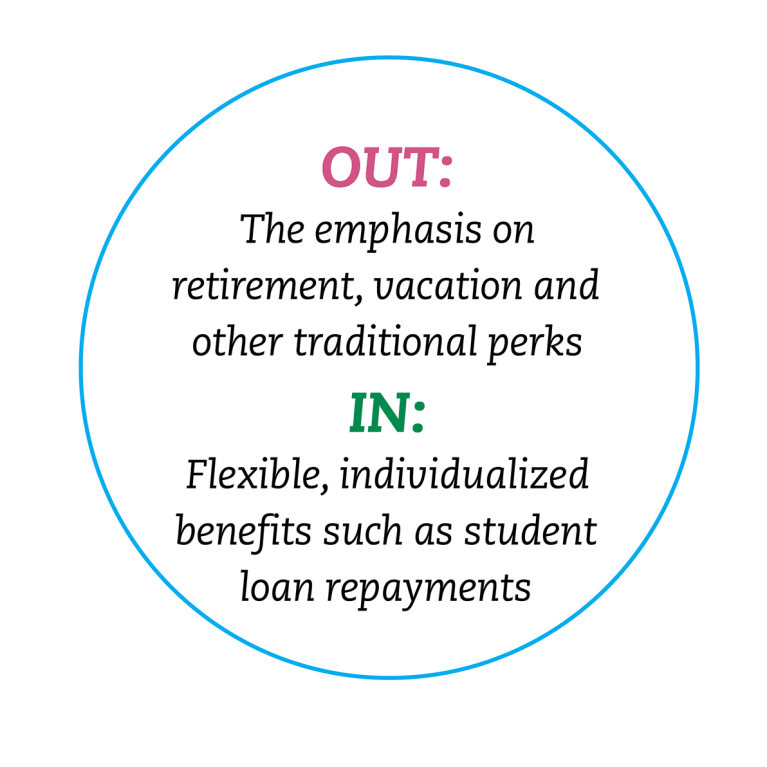
Student loan help is another popular perk with modern workers. “Years ago, the employee entered the workforce wanting to know right from the beginning, ‘What is my retirement plan?’ The entry-level employee is now burdened with educational debt that didn’t exist previously, and they’re asking, ‘What kind of benefits can you provide for student debt?’ ” says Skip Spriggs, senior executive vice president and chief human resources officer at TIAA, a New York City-based financial services company.
WHAT’S NEXT: More companies may embrace a benefits model similar to the approach behind consumer-driven health plans: Employees are allocated a set amount that they can spend on the perks that best meet their needs. That’s the direction LinkedIn went in after it offered a generous paid-parental-leave policy—and heard from employees without children. “We got quick feedback: ‘This isn’t fair. If I don’t have kids, what will you do for me?’ ” says Pat Wadors, the company’s senior vice president of global talent organization. So in 2015, the business piloted Perk Up, a benefit that provides up to $500 a quarter for workers to spend on lifestyle perks such as massages, a personal trainer or a professional dog-walker.
3. Feedback Becomes Fluid
THEN: Companies relied heavily on annual reviews to assess employees’ performance and provide feedback—and some used draconian strategies that pitted workers against one another. At Microsoft, for example, managers relied on stacked ranking, or the “rank and yank” style of employee assessment, in which the employees with the lowest ratings tended to end up looking for other opportunities in the company—or elsewhere.
NOW: Companies are adopting a less formal and more flexible approach. After Microsoft moved away from stacked ranking in 2013, managers began using a process called Connects, in which workers get real-time feedback without structured reviews. Instead of numbered rankings, it’s about the employees’ impact over the last two to three months, their anticipated future impact, what they learned from various experiences and how they grew professionally, says Chuck Edward, head of global talent acquisition at Microsoft, which employs 110,000 people worldwide. And instead of encouraging competition among colleagues, the system fosters collaboration. Employees are assessed on how they worked with their teams and contributed to others’ success. That’s a welcome approach, especially among Millennial workers. Nearly 6 out of 10 said they have been upset by a performance review, and most prefer ongoing conversations about their performance, according to a study by HR outsourcing company TriNet.
85% of Millennials would feel more confident in their current position if they had more-frequent performance conversations with their managers.
WHAT’S NEXT: No one is sure. While experts believe that the move away from a once-a-year gathering of feedback is a step in the right direction, nailing down the best process for evaluating employees in a way that benefits both company and worker remains elusive. “Ten years ago, I told people if I could find a good appraisal system, I’d be rich,” says Pamela Harding, SHRM-SCP, CEO of Enumclaw, Wash.-based Metzano, which operates the LinkedIn group Linked:HR. “Ten years later, it still doesn’t exist.”
4. Technology Moves Work Beyond the Office
THEN: People were starting to take advantage of digital technology to work remotely and outside of traditional business hours, but employers that offered telework options were still the exception rather than the rule.
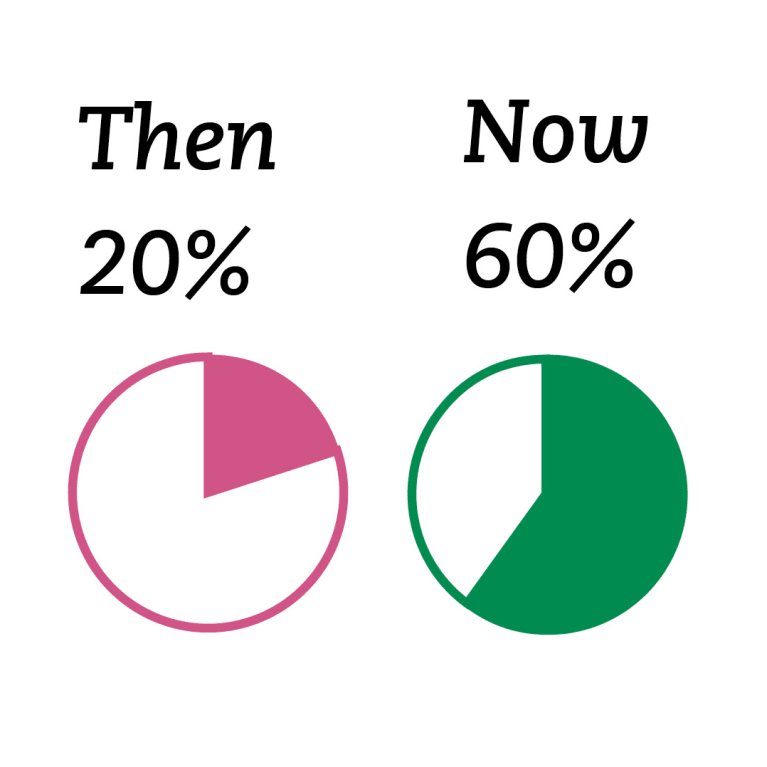
NOW: A Society for Human Resource Management study showed that three times as many companies offered telework last year than did in 1996. That gives leeway to both workers and employers, who can vastly expand their pool of job candidates. “It doesn’t have to be someone local for a job,” Harding says. Companies “can work with someone across the world.”
Flexible work arrangements and schedules have also brought about a different way to evaluate work. Long hours and face time used to be mandatory at some companies. Now, it’s not so much about time served but rather about what gets done. “It goes right back to getting your work judged by getting the task completed,” Harding says.
WHAT’S NEXT: The age-old problem with new technology, though, is that the human element often gets lost. In the next decade, it will be up to HR managers to instruct workers on how to communicate outside of e-mail and social media. “We have to teach them how to shake hands, how to network outside of a computer,” Verrico says.
[SHRM members-only online discussion platform: SHRM Connect]
5. Career Development Is Agile and Gig-Focused
THEN: In 2005, about 10 percent of U.S. workers were employed by a temporary help agency, as an independent contractor or in an on-call position, according to a study from Harvard University’s Lawrence Katz and Princeton University’s Alan Krueger.
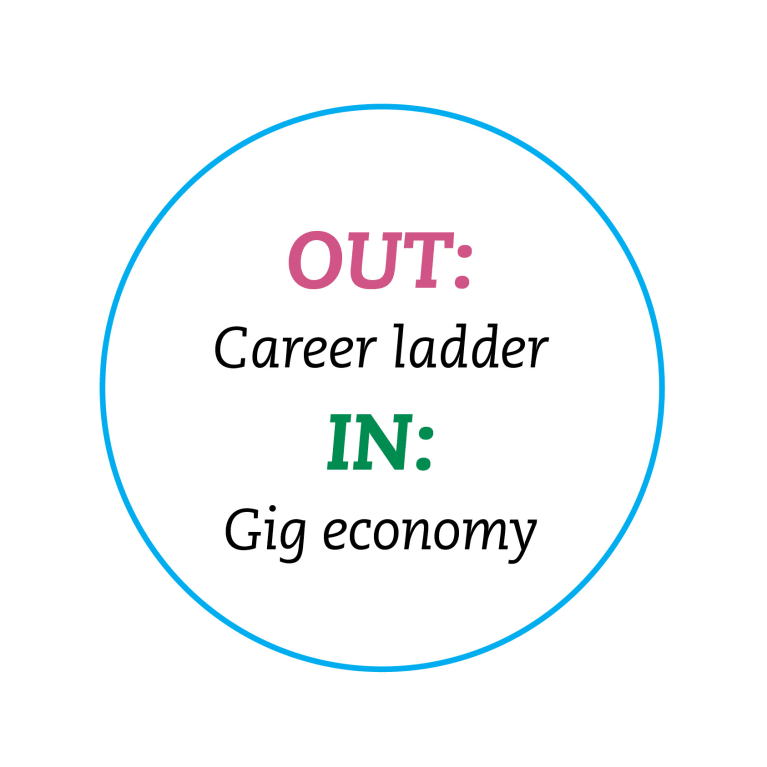
NOW: Goodbye, company career ladder. Hello, gig economy. In the U.S., slightly more than 1 out of 4 workers were gig workers in 2016, according to the McKinsey Global Institute, and that number continues to grow as people seek more independence and opportunities. (By contrast, the decade before that showed little change in the percentage of workers in alternative work arrangements.) The growing Millennial workforce is more focused on racking up new experiences than on banking time at one organization (or even in one field for an entire career), and HR managers are adapting.
“Years ago, the old paradigm was that the contract was defined around loyalty and tenure. There is a new social contract, or new business paradigm, in which employees, especially Millennials, are less incentivized by security and benefits and more eager to take on roles that offer new experiences and flexibility,” says Jan Bruce, co-founder and CEO of meQuilibrium, a Boston-based company that helps organizations deal with worker stress. “Instead of buying your loyalty with tenure, we earn it by helping you be agile and purposeful. I can’t buy you for life, but if I give you a great skill and help you in your career, then you will be loyal to me while you are there.”
That includes offering more opportunities to entrepreneurial independent contractors—contingent workers who work on a per-project basis and are not employees of any one company.
WHAT’S NEXT: The gig economy—driven as much by the economic downturn of 2008-09 as by the influx of Millennials in the workforce—will present challenges in the next decade for HR, including whether and how to provide benefits to contractors and manage intellectual property rights when a person has several different employers, Wadors says. But ultimately, workers and companies will benefit from the trend. “If we become more agile in [talking to] the workforce and listening to their choices, we can create more flexibility and save money” by streamlining staffing, she says.
6. Analytics Change the Game—Slowly
THEN: Some HR managers were experimenting with using metrics to measure the cost and impact of workforce programs and HR initiatives, but few HR professionals had any background in data analysis.
NOW: Although there’s growing recognition of the need for HR practitioners with expertise in data skills, the number of organizations actually leveraging workforce data is still relatively low. According to a 2015 report by Deloitte, less than 9 percent of respondents said their organizations had a strong team in place that could handle data analysis within HR.
32% of companies say they are ready to begin using predictive analytics.
WHAT’S NEXT: While analytics have gotten off to a sluggish start, the use of data to assess and improve everything from recruitment to health and safety to succession strategies will be the hottest and biggest game-changing trend in HR. In fact, nearly one-third of companies said they were ready to make the leap to using full, predictive analytics, according to the Deloitte study. “It’s going to impact everything—what makes the best team, who are the best [job] candidates and who is at risk in the organization,” Bischoff says. “We’re going to see it explode in the next few years.”
Predictive analytics will take metrics to a new level by pinpointing whether job candidates share the same characteristics as an organization’s best-performing employees. Data will also be used to promote wellness by identifying behaviors that lead to higher illness rates or by determining which parts of the company have the best and worst accident rates.
“The … artificial intelligence behind the analytics is going to get more and more souped up, more advanced,” Edward says. But “the human element of needing to discern what matters and why—that isn’t going away.”
Susan Milligan is a freelance writer based in Washington, D.C.
Was this article useful? SHRM offers thousands of tools, templates and other exclusive member benefits, including compliance updates, sample policies, HR expert advice, education discounts, a growing online member community and much more. Join/Renew Now and let SHRM help you work smarter.
Related Articles

Learn how Marsh McLennan successfully boosts staff well-being with digital tools, improving productivity and work satisfaction for more than 20,000 employees.

The proliferation of artificial intelligence in the workplace, and the ensuing expected increase in productivity and efficiency, could help usher in the four-day workweek, some experts predict.

As artificial intelligence technology continues to develop, the demand for workers with the ability to work alongside and manage AI systems will increase. This means that workers who are not able to adapt and learn these new skills will be left behind in the job market.