The State of Recruiting 2025: Insights to Maximize Recruitment from SHRM’s New Benchmarking Report
Research + Insights

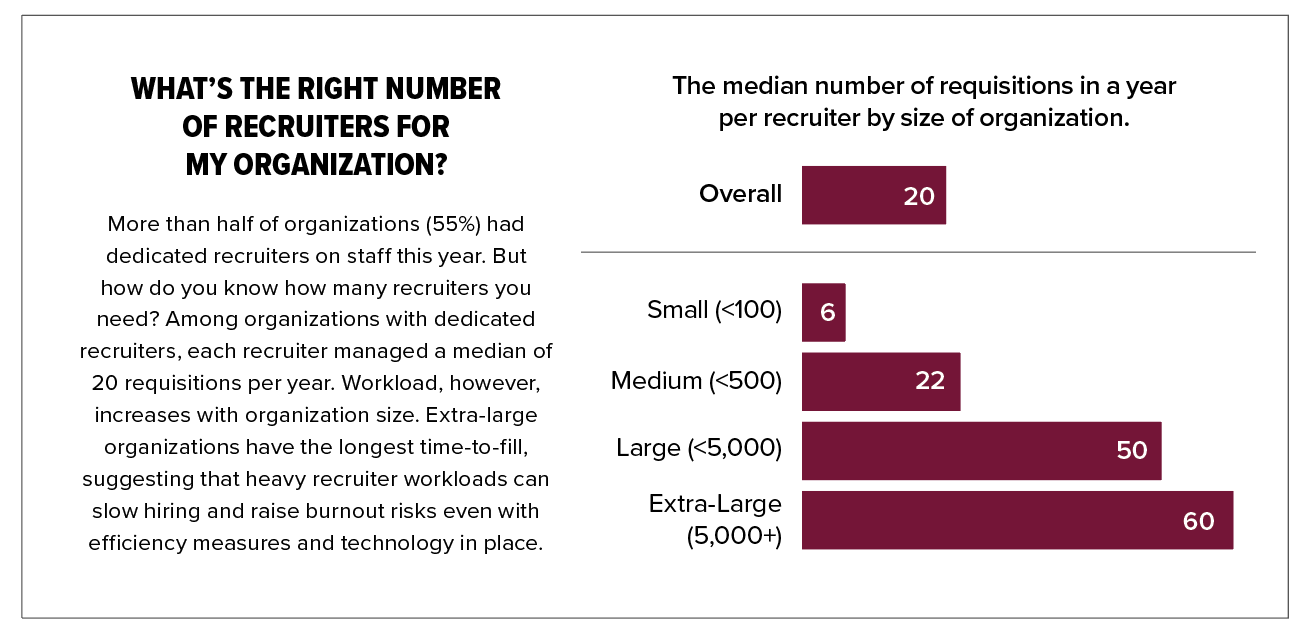
Organizations continue to face intense competition in attracting and retaining talent. Since mid-2021, the unemployed-people-per-job-opening ratio (UJOR) has mostly remained below 1.0, meaning there have almost always been more job openings than unemployed people available to fill them during the period. Recruiters are still grappling with this staffing challenge. In 2025, more than half of recruiting executives (56%) identified talent shortages as a challenge, with 1 in 5 citing it as their organization’s greatest macroeconomic obstacle (Recruiting Executives: Priorities and Perspectives, SHRM, 2025).
To better understand these challenges and how recruiters are responding, SHRM released a new data brief: 2025 Recruiting Executives Benchmarking: Insights to Maximize Recruitment. Drawing on responses from more than 2,300 SHRM members across diverse industries and organizational sizes, this year’s data builds on prior benchmarking efforts to track key recruiting metrics and emerging trends. The following analyses highlight findings designed to equip recruitment executives with actionable benchmarks to strengthen their efforts to attract top talent.
HOW LONG DOES IT TAKE TO FILL POSITIONS?
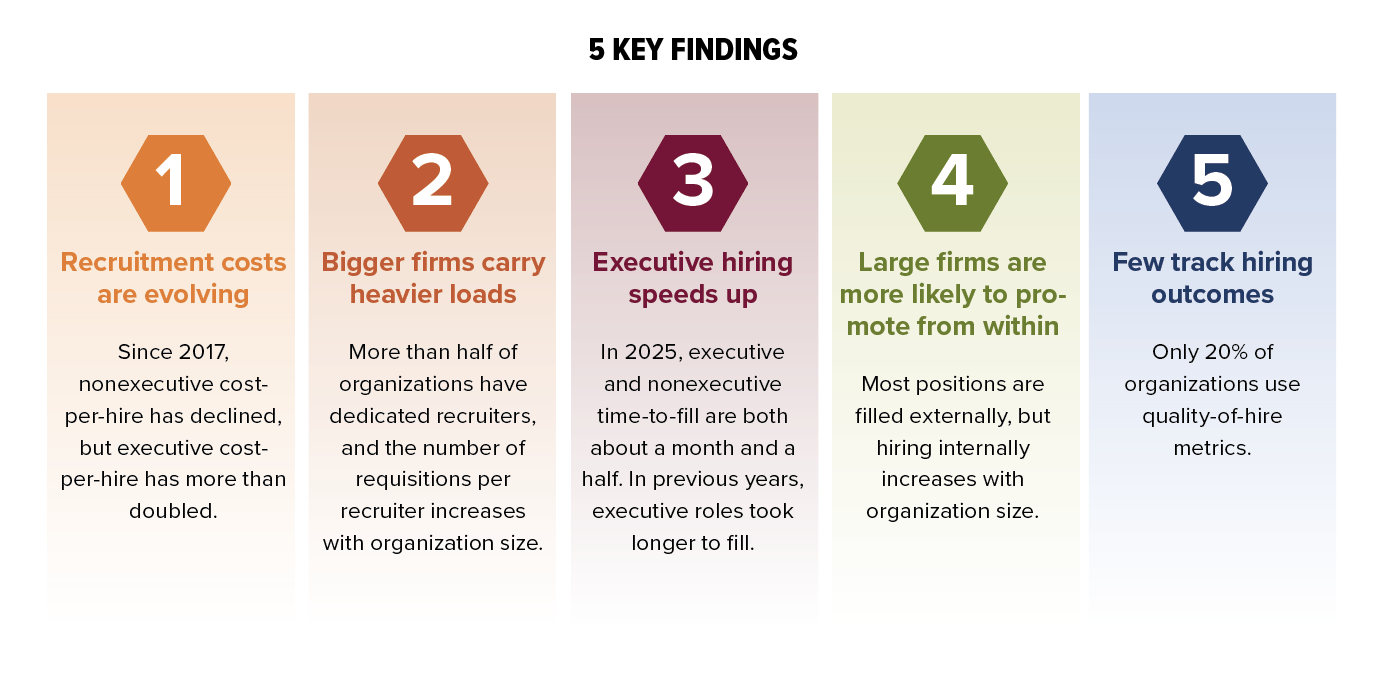
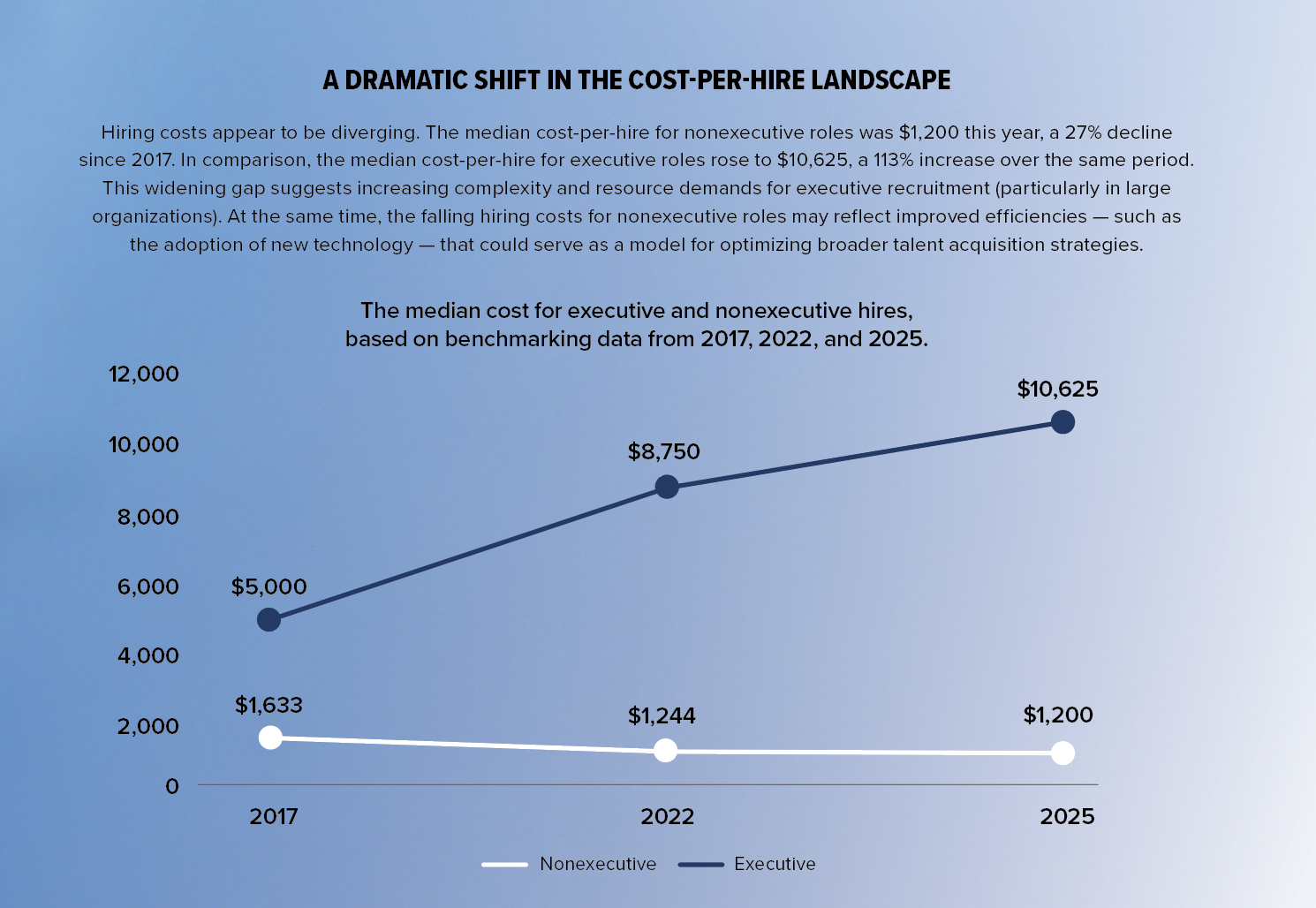
In 2025, median time-to-fill — the period from job requisition to offer acceptance — is roughly a month and a half for both executive and nonexecutive positions. This is a shift from 2022 and 2017, when executive roles typically took 16 and 17 days longer, respectively, to fill than nonexecutive roles. While executive time-to-fill has dropped, costs per hire have increased, suggesting organizations may be investing more to expedite hiring for critical roles. These trends highlight the evolving balance between speed and cost in recruitment.


MESSAGE FROM THE RESEARCHERS
Unlocking the Power of Internal Talent: Why Organizations Must Rethink Hiring Strategies
How often does your organization promote or redeploy existing talent into open roles? For many, the answer is, “Not often enough.” According to a SHRM data brief, 2025 Recruiting Executives Benchmarking: Insights to Maximize Recruitment, hiring remains overwhelmingly external.
That’s especially true in hiring for the executive ranks. Only extra-large organizations (50%) and large organizations (25%) report leveraging internal pipelines to fill executive positions. Small and medium organizations rely almost exclusively on external sources to fill executive roles.
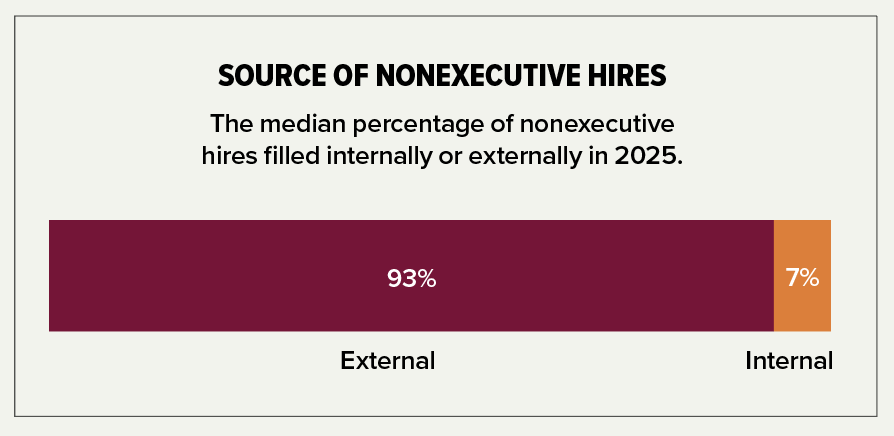
Organizations are more likely to hire from within for nonexecutive positions, but it’s still rare. Overall, only 7% of nonexecutive positions were filled internally in 2025 (see chart). In general, the 2025 median rates of internal and external hires remain consistent with 2022 data.
This heavy reliance on external talent is increasingly out of step with today’s labor market dynamics. Recruitment challenges persist: SHRM’s 2025 Talent Trends research reveals that 51% of organizations report too few applicants, 50% struggle with losing talent to competitors, and 41% cite rising rates of candidate “ghosting.” These issues mirror those seen in 2022 and 2024, underscoring that the external market is not becoming any easier to navigate.
However, there are signs of progress. In 2025, 35% of organizations reported using an internal talent marketplace, up from 25% in 2024 (2025 Talent Trends, SHRM). This growth reflects a shift in mindset: More employers are recognizing that their existing workforce is their most valuable source of future talent. Internal mobility not only accelerates time-to-fill but also enhances engagement and retention by offering employees clear pathways for growth. Organizations that treat internal talent as a strategic advantage are better equipped to adapt to market disruptions, retain top performers, and outpace competitors.
3 Steps to Strengthen Internal Talent Pipelines
1. Create a Culture of Talent Mobility
Encourage employees to explore opportunities across departments and functions. This can be achieved by implementing rotational programs, cross-functional projects, or even “gig” assignments within the organization. A culture that normalizes internal movement fosters innovation, reduces silos, and ensures employees feel empowered to grow without leaving the company.
2. Redesign Job Postings to Prioritize Internal Candidates
Make internal opportunities more accessible by simplifying the application process for current employees. Ensure job postings clearly outline transferable skills and development opportunities, rather than focusing solely on external experience. This approach signals to employees that their growth is a priority and encourages them to apply for roles they might otherwise overlook.
3. Leverage Data to Identify Hidden Talent
Use workforce analytics to uncover untapped potential within your organization. Skills inventories, performance data, and employee aspirations can help identify candidates who are ready — or nearly ready — for new roles. Proactively matching employees to opportunities not only reduces time-to-fill but also demonstrates a commitment to their career development.
Why This Shift Matters Now
Relying heavily on external talent may feel familiar, but it is becoming increasingly unsustainable. The external market is more competitive than ever, with no indication of relief. Internal talent, by contrast, is a proven and often faster-to-deploy asset. Leveraging it effectively creates measurable business advantages: faster time-to-fill, reduced recruitment costs, stronger retention, and greater organizational agility.
Organizations that fail to prioritize internal mobility risk falling behind competitors that are already investing in these systems. Those that take action today — by creating a culture of talent mobility, redesigning job postings to prioritize internal candidates, and leveraging data to identify hidden talent — will be positioned to respond to disruption with confidence and to unlock the full potential of their workforce.

Ragan Decker, Ph.D., is the manager of Executive Network and enterprise research at SHRM.
Related Articles

Transform HR with mobile technology to streamline workflows, enhance communication, and boost employee engagement across distributed teams.

A new study found that talent development practitioners believe performance-based assessments are more effective at measuring employee learning outcomes than knowledge tests.

As AI makes deeper inroads into organizations, employee concerns about the technology continue to grow. Here's how HR leaders can address the fear of AI among their own staff, as well as in the wider organization.